
1 hours 45 minutes/ 90 marks/ 35% of qualification
Q1) Assessing media language in relation to an unseen audio-visual or print resource
Q2) Comparison question assessing representation in one set text product and an unseen audio-visual or print resource in relation to media contexts
Q3) media industries
Q4) Audiences
Advertising and marketing:
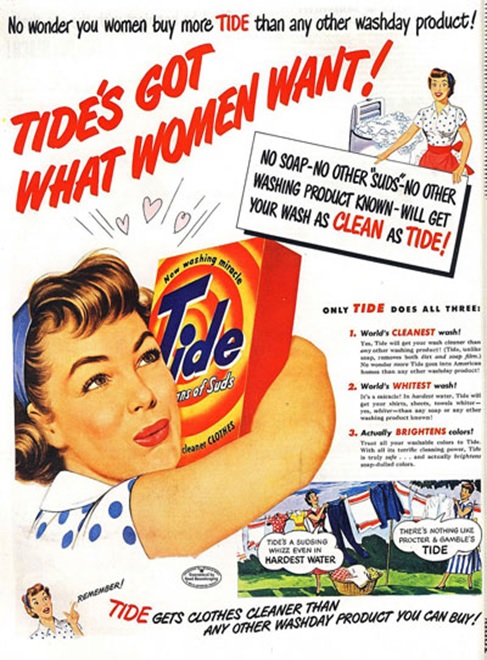
Tide (1950)
Media Contexts:
- Social and cultural: Women returned to their domestic roles after formally taking on men’s roles during the war. As a result these products were still targeted primarily at women. More people had disposable income allowing them to purchase more expensive or luxury products. Commercial television arrived in the 50’s causing a whole new platform for advertising, this increased sales dramatically.
- Historical: As it was made in the post war boom of the 1950’s, new technologies were being developed rapidly, specifically in the domestic sphere. These products were related to the American Dream.
Media Language- Semiotics (Barthes): Study of signs and their meaning.
- The main image of the woman is overlapping the other images showing the importance of the product
- The use of red connotes passion, like the women are passionate about the product
- The Good Housekeeping stamp implies that the product is reliable and is bound to be of good quality
- The hearts drawn above the main image show how the character loves the product
- The highlighting of certain words with red font creates hyperbolic meaning and intensifies the statements.
Representation- Stereotyping creates social inequality (Hall): Representations are constructed through signs and codes understood by the audience. Stereotypes reduce people to a few characteristics as they are reinforced over time.
- Women are seen as domestic figures centred around the home, due to the use of the Tide product, washing machines, washing line
- Women like to gossip: the use of speech bubbles in the bottom corner
- Women are superficial and materialistic: the use of makeup and the love for the material product of Tide
Representation- Gender and Identity (Gauntlett): The idea that the media presents us with tools to construct our identities.
- Women from the 50’s found the hairstyle the women have in the advert very stylish and popular, by using it in the advert more people would be swayed to have it.
- The audience may want to be the perfect housewife and see from the images that they need to be made-up. skinny and shapely
- The idea that they need to buy Tide to be the picture perfect housewife and live the American Dream
Audience- Cultivation theory (Gerbner): The idea that we are influenced by the media we constantly consume, and it shapes our thoughts.
- Women looking at the Tide advert will be persuaded to buy it through: the idea they can have the ‘whitest’ and ‘cleanest’ wash,
- that Tide is an innovative product,
- that you would be happy if you buy the products (from seeing the women on the poster happy)
- everyone else is using the product: “goes into more American Homes than any other washday product”.
Audience- Reception theory (Hall): The idea that there are three hypothetical positions from which messages and meanings may be decoded.
- The Dominant reading: The encoders meaning is fully understood and accepted. The audience feel that Tide is the greatest cleaning product, they are completely won over by the advert and feel that they must get the product. They love the idea of the perfect domestic life.
- The Negotiated reading: The encoders meaning is acknowledged but adapted to better fit the decoders own individual experiences or context. The audience are persuaded to buy the product, but possibly feel that their lifestyle will not be completely changed by it.
- The Oppositional reading: The message is understood but the decoder disagrees with it, reading it in an oppositional way. The audience feel that the product shows women in a one dimensional light, it is very stereotypical and shows women to have no personalities.
Kiss of the vampire (1963)
Media Contexts:
- Social and political: The 1960s is often seen as the start of women’s sexual liberation, aided by events such as the introduction of the contraceptive pill in 1960. More women than ever were entering paid work and sixties feminists were campaigning for equality. In America, equal pay legislation was passed in 1963. Older stereotypes of women as passive victims of men and more modern ‘male fears’ of women challenging male dominance could both be seem to be encoded in this film poster.
- Economic: Produced by Hammer film Production and distributed by J. Arthur Rank and Universal, Kiss of the Vampire was intended to be the second sequel to 1958s Dracula, although the film’s script actually makes no reference to Stoker’s character. This is perhaps to distance itself from unfavourable comparisons to the superior Christopher Lee who starred in the original film.
- Cultural: The 1960s audience for this advert could be assumed to be familiar with the codes and conventions of a ‘monster movie’ films posters- such as its composition, fonts and representations of ‘the monster’ and its (usually female) victims. Interesting intertexts for comparative study might include: The Evil of Frankenstein (1964) and Blood from the Mummy’s Tomb (1971).
Media Language- Semiotics (Barthes): Study of signs and their meaning.
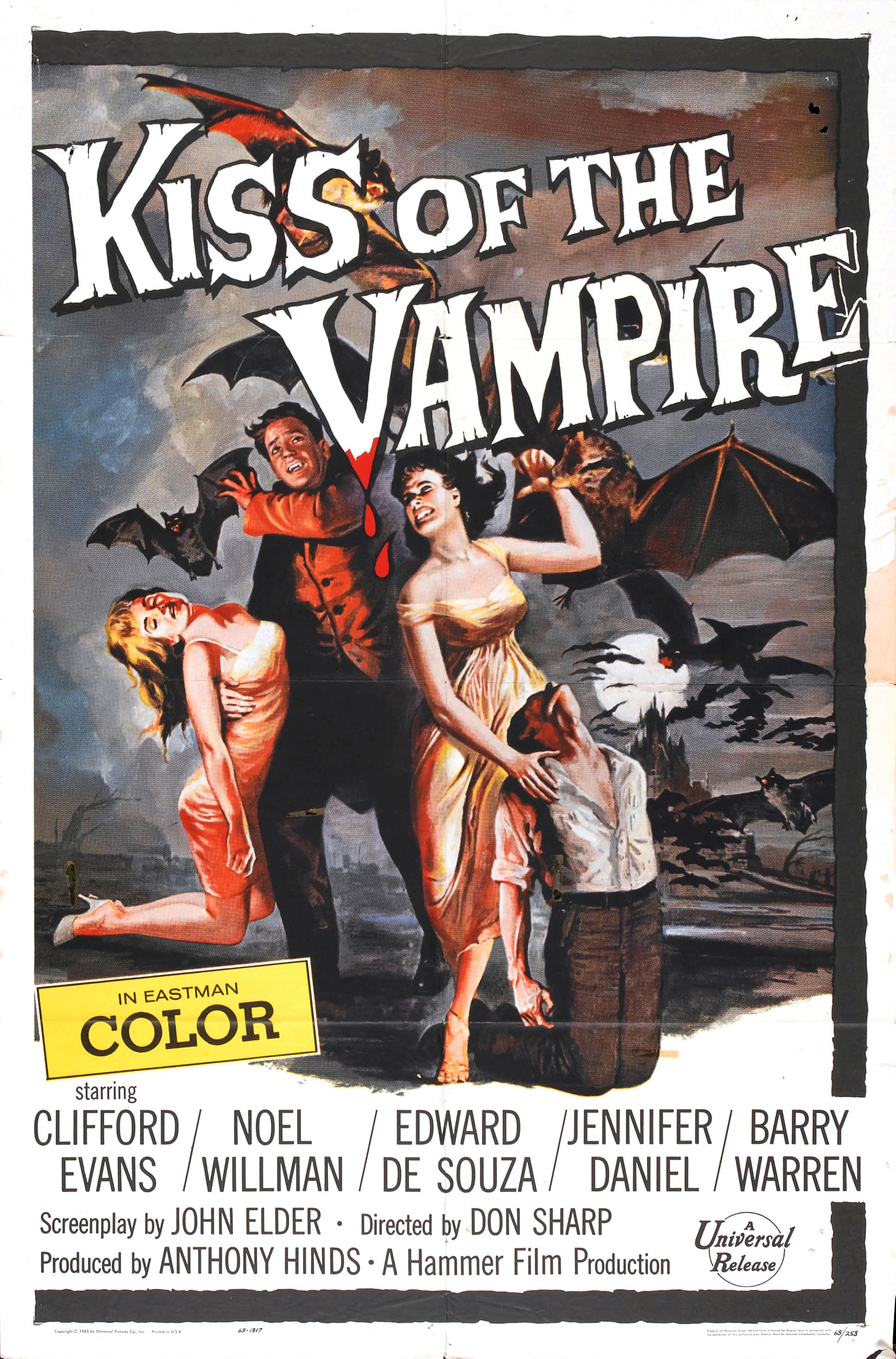
- In the poster both women wear pale dresses made of light materials , these dresses reinforce the femininity by highlighting the curve of their bodies and revealing the flesh on their upper chests and arms.
- The gesture code of the woman on the left is that of the stereotypical passive victim of the ‘monster’, his power highlighted by the fact that he’s holding her by just one arm.
- Baring her teeth with her arm raised almost fist-like as she’s being bitten by the bat, the second woman’s gestures are more aggressive and the submissive pose of her male represents her in a non-stereotypically dominant way.
Representation- Stereotyping creates social inequality (Hall): Representations are constructed through signs and codes understood by the audience. Stereotypes reduce people to a few characteristics as they are reinforced over time.
- Women are represented as weak and at the mercy of men
- Men are hagemonic and powerful, they are the main characters
- These are challenged in the poster as one of the woman is strong and one of the men are on their knees submissive.
Representation- Gender and Identity (Gauntlett): he suggests that the media present us with tools that we can use to build our own identities. We can pick and mix which aspects we want to use, he thinks that unlike in the past we have now been offered a more diverse range of stars from whom we may pick and mix.
- In the 60’s there would have been limited representations in the media as the characters were usually white or at least all the “good” characters were, this is due to the fact that people were still racist on the whole and segregation continued until the 70s.
- Negative stereotypes are portrayed in the poster and I assume in the movie too, this is where men are controlling and violent and women are submissive and at the mercy of men.
Audience- Cultivation theory (Gerbner): The idea that we are influenced by the media we constantly consume, and it shapes our thoughts.
- Dated representations would make the audience of the time feel like we are very subjected to our stereotypes as there were very common in the 60s.
- Men may assume all women are submissive and weak
- Women may assume all men like to take charge and are strong
Audience- Reception theory (Hall): The idea that there are three hypothetical positions from which messages and meanings may be decoded.
- The Dominant reading: The encoders meaning is fully understood and accepted. The audience enjoy the film and find it entertaining as they like the thriller genre.
- The Negotiated reading: The encoders meaning is acknowledged but adapted to better fit the decoders own individual experiences or context. The audience find the film enjoyable but may find elements of it confusing or may not enjoy the genre.
- The Oppositional reading: The message is understood but the decoder disagrees with it, reading it in an oppositional way. The newly revolutionised female audience may not agree with their negative stereotyping and boycott the film.
Water Aid (2016)
Media Contexts:
- Social and Cultural: The advert was made to raise money for clean water in the world. Usually these adverts are made to evoke pity out of the audience showing negative representations in order to get a response, Water Aid doesn’t do this. This helps those who have become desensitised to traditional fundraising techniques.
- Economic: The charity works with 34 countries worldwide, they directly reach 995,000 people with clean water. The advert was broadcast during prime time TV, asking for a £3 one time donation.
Media Language- Semiotics (Barthes): Study of signs and their meaning.
- The song- Will be recognised by the audience of 30-40 year old’s, it connotes happiness and suggests we should be grateful for water, even the rain.
- Claudia- she represents hope as a result of charity work, a symbol that your donations do matter, the audience can compare her life with the life of their children and be prompted to donate to help other children like her.
- The tap- this symbolised the hope that Claudia has, that her life will get better. It suggests a unity and togetherness of their community.
- The radio- shows the digital divide between us and Claudia, we should be grateful for what we have.
Representation- Stereotyping creates social inequality (Hall): Representations are constructed through signs and codes understood by the audience. Stereotypes reduce people to a few characteristics as they are reinforced over time.
- We pity Claudia even though she has been helped because we can still see the large divide between us and her.
- The dry landscape she calls her home visually shows the lack of water and the lack of resources.
- The clothes they wear look like they have been donated, further showing how they have been helped by charities, this heightens the representations of people in poorer countries
Representation- Gender and Identity (Gauntlett): The idea that the media presents us with tools to construct our identities.
- We should become more charitable and help those in need
- We can follow in Claudia’s footsteps and not base our lives around material items as much, instead taking pleasure in nature
- The audience may want to become a bigger figure in their community after seeing how happy Claudia is with hers.
Audience- Cultivation theory (Gerbner): The idea that we are influenced by the media we constantly consume, and it shapes our thoughts.
- Usually charity adverts show people in pain, in dyer need of help, this gets donations and the audience think it will help alleviate their pain
- This Water Aid advert opposes Gerbners theory as it offers unconventional perceptions of people in poorer countries showing them as happy and grateful for their help.
Audience- Reception theory (Hall): The idea that there are three hypothetical positions from which messages and meanings may be decoded.
- The Dominant reading: The encoders meaning is fully understood and accepted. The audience will donate money to Water Aid and strive to help them positively
- The Negotiated reading: The encoders meaning is acknowledged but adapted to better fit the decoders own individual experiences or context. The audience may feel pity and feel a need to donate to the cast, but they won’t necessarily follow through with their promise.
- The Oppositional reading: The message is understood but the decoder disagrees with it, reading it in an oppositional way. The audience may have become desensitised to charity adverts and will not be affected by the contents, or could be racist.
Music video:
Formation (2016)
Media Contexts:
- Social: The video promotes female empowerment and the “formation” of ladies coming together to overcome obstacles. Beyonce inspires her female audience with her powerful and strong stature that alludes to a sense of strength and power.
- Economic: -Beyoncé started a Hurricane Katrina fund in 2005 -Raised money for Haiti relief in 2010 -She headed a campaign in 2013 called “Chime for a change” which aimed to spread female empowerment -She funded $7 million housing complex for homeless in Houston, which is a predominantly Black community, and Beyoncé’s home.
- Political: Beyonce is an advocate for the black lives matter campaign, the video shows her support with the use of an African American cast and no violence in the video, also the tagline of “stop shooting us” targeted at the white police.
- Cultural: The intertextuality of the Alchemist (a symbol of truth and spiritual freedom, a socially conscious liberator).
Media language- Semiotics (Barthes): Study of signs and their meaning.
- Antebellum dresses- worn by slave owners, as they’re being worn by Beyonce and other black women it shows that they’re reclaiming their history and proving they can’t be owned.
- All female dancers- coincide with the tagline “Okay ladies now lets get in formation”, show that women as a collective are empowering each other and coming together to challenge the patriarchy
- Old fashioned video cassette filter- shows that women have been challenging this inequality for a while, it also gives texture to the video
- Sinking police car- homage to the flood in New Orleans and the fact that the corrupt police had no preparations in the even of a disaster leading to thousands of deaths.
Representation- Stereotyping creates social inequality (Hall): Representations are constructed through signs and codes understood by the audience. Stereotypes reduce people to a few characteristics as they are reinforced over time.
- There are a lot of stereotypes around black people and their ethnicity for being violent and villains in the media, Beyonce contradicts these by showing how they create a beautiful family and unity together and are oppressed by other ethnicity’s for the colour of their skin.
- Black people are also subjected to being viewed as exotic, Beyonce manipulates her own ethnic stereotype by using visual codes like clothing and choreography to reinforce this “desirable” trait.
Representation- Gender and Identity (Gauntlett): he suggests that the media present us with tools that we can use to build our own identities. We can pick and mix which aspects we want to use, he thinks that unlike in the past we have now been offered a more diverse range of stars from whom we may pick and mix.
- Beyonce’s music video offered a range of representations on gender and ethnicity.
- The sexualisation of Beyonce is opposed with her strong confident star persona, the audience may be inspired by her strength and aspire to be her, a modern day activist.
- Also the plentiful representation of black people in her music video will give others the courage they need to be themselves, she is a African American woman who is a billionaire as a result of her hard work and success showing others round the world that you can achieve whatever you put your mind to.
Newspapers:
The Daily Mirror (US election 2016)
Media Contexts:
- Social: Due to technological change there has been a movement of news outlets online, this makes it more accessible to the readers and available at any time, anywhere, they also offer a more interactive element to the news. It is produced for a lower-middle class/working class readership. They use binary opposites like “us and them” to target the audience.
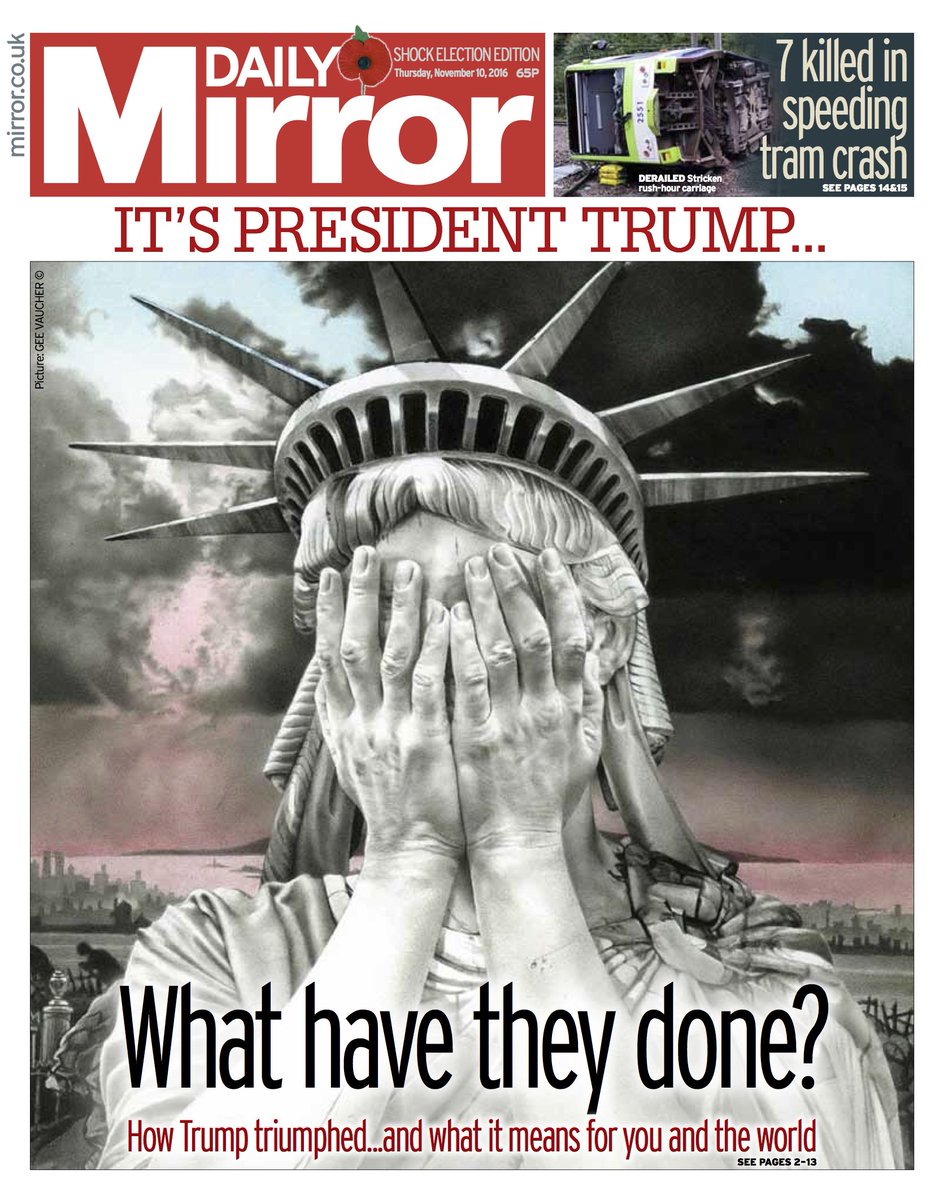
- Political: The Daily Mirror is left wing bias, this is clearly demonstrated with their political sections and favouritism towards Labour. The Dramatic headline “What have they done?” uses rhetorical language to involve the readers and prompt discussion. The header linked with the image shows how dramatic they are and how they think the liberation and freedom in America will cease. It is Pro EU and anti Brexit.
- Economic: They have an average issue readership of 1,691,000 people
- Cultural: The Daily Mirror is a tabloid but has become more political recently. It is regulated by the Independent Press Standards after the Leveson inquiry that showed a phone hacking scandal, they deal with complaints and harassment issues.
Media language- Semiotics (Barthes): Study of signs and their meaning.
- Connotation and Denotation are viewed in newspaper articles
- The image of the Statue of Liberty crying shows the fall of an era and expected imminent doom
- The red logo suggests that it is a tabloid newspaper
- The negative response to the election of Trump shows that even though he is left wrong they still oppose his win, this is seen similarly with the vote of Brexit which they opposed, this shows that they are not 100% left wing but are more left wing central.
Representation- Stereotyping creates social inequality (Hall): Representations are constructed through signs and codes understood by the audience. Stereotypes reduce people to a few characteristics as they are reinforced over time.
- Labour and left wing policies are seen as preferable and the desired end result
- Conservatives and right wing supporters are wrong
- Celebrities are “other” than us and need to be viewed in the spotlight critically
Audience- Cultivation theory (Gerbner): The idea that we are influenced by the media we constantly consume, and it shapes our thoughts.
- Newspapers and opinion leaders and will shape our thoughts
- Readers of the Daily Mirror are likely to become more left wing or Labour supportive.
Audience- Reception theory (Hall):The idea that there are three hypothetical positions from which messages and meanings may be decoded.
- The Dominant reading: The encoders meaning is fully understood and accepted- The readers agree with the negative associations of Trump being elected as they oppose his views and would have preferred someone else
- The Negotiated reading: The encoders meaning is acknowledged but adapted to better fit the decoders own individual experiences or context- The readers agree with negative associations of Trump but they dislike him for reasons not mentioned.
- The Oppositional reading: The message is understood but the decoder disagrees with it, reading it in an oppositional way- The readers are in favour of Trump and think that he would be a good leader and a great change for the country
Industry- Power and Media industries (Curran and Seaton): The idea that media is controlled by a small number of companies primarily driven by the logic of profit and power. This generally limits variety, creativity and quality. More socially diverse patterns of ownership help to create the conditions for more varied and adventurous media products.
- The biggest press owner is News Corporation, the empire owns: The Sun, The Times, The Sunday Times and Sun on Sunday
- Daily Mirror is owned by Trinity Mirror, along with The Sunday Mirror and The People
- As the newspaper industry is in the hands of the few and given to the many it shows that the news we are told is filtered by the same people and therefore we get bias results
- Also news that is deemed as not as important by the head office will be left out and we wont be given the full story on certain events.
Radio:
Late Night Women’s Hour (2016) BBC Radio 4

Media Contexts:
- Social: The show is presented by Lauren Laverne who is a similar age to the target audience and is known for her involvement with the arts and music. Each episode is based around a theme and involves informal and in-depth discussion eg anxiety, women in sport and friendship. The program reflects the ethos and inclusive nature of the BBC and is linked to woman’s hour that has been going for 70 years.
- Political: The guests may come from various political and educated backgrounds, giving a wide variety of input for the listener to listen to and decode.
- Economic: The BBC is publicly funded by the TV licence fee and therefore has to cater to a lot of different people, this segment of LNWH shows hoe they are trying to target young educated women.
- Cultural: The introduction of LNWH to the BBC’s schedule shows their awareness of the need to cater for all areas of society. The topics discussed in the programmes reflect what is of interest and concern to young women in society today and cater for a specific social group who have previously been under-represented.
Audience- Reception theory (Hall): The idea that there are three hypothetical positions from which messages and meanings may be decoded.
- The Dominant reading: The encoders meaning is fully understood and accepted. Listeners accept the idea of a woman centred broadcast and enjoy the informal tone it takes on, they also agree with the discussions made.
- The Negotiated reading: The encoders meaning is acknowledged but adapted to better fit the decoders own individual experiences or context. Listeners enjoy the program but may not relate to all the topics talked about and instead may input their own opinions in their heads.
- The Oppositional reading: The message is understood but the decoder disagrees with it, reading it in an oppositional way. The listener may be sexist or may oppose all the discussions in the program causing them to either discontinue listening or listening to it just to make derogatory remarks.
Industry- Power and Media industries (Curran and Seaton): The idea that media is controlled by a small number of companies primarily driven by the logic of profit and power. This generally limits variety, creativity and quality. More socially diverse patterns of ownership help to create the conditions for more varied and adventurous media products.
- The BBC is a major deliverer of radio and television programmes.
- The BBC gives relative freedom to creators as budget is not as important due to the funds they’re given by the public.
- As a public service broadcaster the BBC have to appeal to a wide variety of people so they are likely to oppose the idea of the theory.
Video games:
Assassins Creed 3: Liberation (2012)

Media Contexts:
- Social: The videos game is regulated by PEGI but since 2012 games are regulated by VSC. Blame of violent behaviour has been linked with video games for a while, the age rating are often ignored which causes distress with parents and the government. The game is a computer role playing game and uses the first female lead character for assassins creed.
- Historical: Video games have become increasingly popular and the profile of gamer’s has changed and now it is no longer just for teenage boys and instead a source of entertainment for all genders and ages. Playing video games is also taken a lot more seriously.
- Economic: PlayStation Vita is part of an 8th generation of gaming technology that was released to compete with the Nintendo 3DS. The game was initially only available on PS Vita but then was released in 2014 to a larger range of consoles and platforms to expand the audience reach.
- Cultural: The game casts Aveline, a young woman living in New Orleans before and during the American revolution, therefore linking to Assassins creed III. She is mixed race, there were amass of female reviewers giving a positive response to the game as they could identify with her, their only complaint being that it was so short. The use of a female protagonist shows how the gaming industry is trying to update the stereotypes they have created over time and are trying to show that women are no longer just sexualised and secondary characters.
Audience- Media effects (Bandura): Albert Bandura suggested that we learn behavioural traits from media. His theory suggests we have ideas implanted in our minds by the media, this could change our attitudes, beliefs and emotional responses to certain things.
- Children learn aggressive behaviour from video games
- We imitate what we see in the media
- Age restrictions are put in place to ensure that we only play what is targeted at us, but these often get ignored.
Audience- Reception theory (Hall): The idea that there are three hypothetical positions from which messages and meanings may be decoded.
- The Dominant reading: The encoders meaning is fully understood and accepted. The audience enjoy the new female protagonist and enjoy playing as her with her dramatic story line.
- The Negotiated reading: The encoders meaning is acknowledged but adapted to better fit the decoders own individual experiences or context. The player may enjoy the game but feel annoyed about the length of the game or a feature that they wish to fix.
- The Oppositional reading: The message is understood but the decoder disagrees with it, reading it in an oppositional way. The player dislikes this turn that Assassins Creed have taken and would prefer to stick to a male character and stereotypical hero story line.
Industry- Power and Media industries (Curran and Seaton): The idea that media is controlled by a small number of companies primarily driven by the logic of profit and power. This generally limits variety, creativity and quality. More socially diverse patterns of ownership help to create the conditions for more varied and adventurous media products.
- The game was produced by Ubisoft , it was the best selling game in the UK on the week of its release
- It was the biggest release launch in the companies history and third biggest launch of any game in the UK in 2012
- Continued marketing includes game playing videos on YouTube introducing newcomers to the game and suggesting different playing techniques.
Film:
Straight Outta Compton (rated 15)

Media Contexts:
- Social: They used viral marketing to promote the film, releasing the “straight Outta …” campaign. The company also created a special edition wireless headphone for the movie.
- Political: The narrative of the film follows political situations of the time, including racial tension and poor relations between the police and young black people. The band NWA created controversy with their misogynist attitudes and explicit name.
- Economic: The film made over $200 million and became the highest grossing music biopic of all time and was nominated for an Oscar for best original Screenplay. The established stars with a strong fan base limited the financial risk of the movie, it was produced by Ice Cube and Dr Dre. The soundtrack to the film, of the same name, was released at the same time, contributing to their success.
- Cultural: The trailers shown on Facebook were seen as problematic because they changed depending on the demographic of the viewer, the trailer was red band because of its explicit nature, e.g. less rap/ less swearing. The NWA were significant in terms of cultural change in that they became successful artists who broke out of the social restrictions of their communities, offering a positive representation of ethnicity.
- Historical context: A the film is set in the 80s it gives a view of life at the time and links to historically important events related to racial tension.
Industry- Power and Media industries (Curran and Seaton): The idea that media is controlled by a small number of companies primarily driven by the logic of profit and power. This generally limits variety, creativity and quality. More socially diverse patterns of ownership help to create the conditions for more varied and adventurous media products.
- It is produced by Universal pictures and is owned by the huge Conglomerate Comcast.
- The vertical integration is important in terms of cross platform marketing, funding and distribution so reaching a larger audience.
- The huge conglomerate shows how the media is controlled by the minority, and that the big Blockbuster films are created by a limited few, reducing variety and creativity.
 Nadia's Media